

Pain Management Doctors in Huntington NY
Non-Surgical Pain Relief at Orthopedic Spine Care of Long Island
If you’ve been living with chronic back pain, sciatica, neck pain, or another spine-related condition, surgery is rarely the first step — and for most patients, it isn’t necessary at all. Interventional pain management uses image-guided injections, nerve blocks, and minimally invasive procedures to find and treat the source of your pain without an operation.
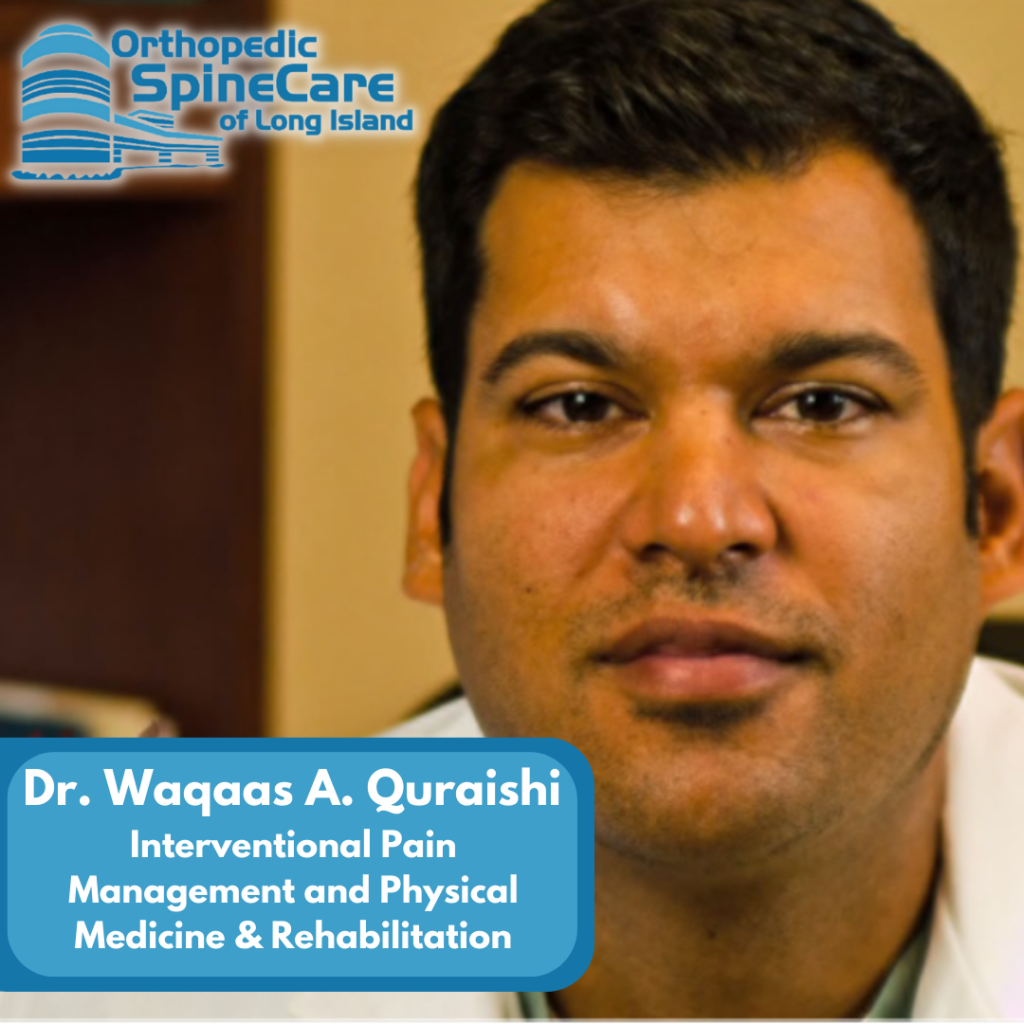
At Orthopedic Spine Care of Long Island in Huntington Station, our interventional pain program is led by Dr. Waqaas A. Quraishi, a double board-certified physician in pain medicine and physical medicine & rehabilitation. He works alongside our orthopedic spine surgeons so that every patient gets the right level of care — conservative when possible, surgical only when truly indicated.
Call 631-847-0200 to schedule an evaluation, or request an appointment online.
Patient Information & Links
What Is Interventional Pain Management?
Interventional pain medicine is a subspecialty focused on diagnosing and treating chronic pain through targeted, minimally invasive procedures. Most procedures are performed in an outpatient setting using fluoroscopic (X-ray) guidance to deliver medication directly to the structure causing pain — a specific nerve, joint, or disc.
The goal is twofold:
- Identify the source of pain. A diagnostic nerve block can tell us whether a suspected nerve or joint is actually generating your symptoms. This information shapes everything that follows.
- Provide lasting relief. Once the source is confirmed, therapeutic injections or procedures can reduce inflammation, interrupt pain signals, or, in some cases, address the underlying problem altogether.
For many patients, this is enough to return to work, exercise, and daily life without surgery. For others, it provides meaningful relief while a longer-term plan — including physical therapy or, in select cases, surgery — is put in place.
Meet Dr. Waqaas A. Quraishi
Dr. Quraishi is the interventional pain physician at Orthopedic Spine Care of Long Island. His credentials are a key reason patients across Long Island are referred here for non-surgical pain care:
- Board Certified in Pain Medicine
- Board Certified in Physical Medicine & Rehabilitation
- Fellowship in Interventional Pain Medicine — Department of Pain Medicine and Palliative Care at Beth Israel Medical Center, New York City, one of the country’s most established interventional pain programs
- Residency in Physical Medicine and Rehabilitation at Long Island Jewish Medical Center, where he was elected Academic Chief Resident
- Active teaching role — Dr. Quraishi continues to lecture and teach residents at LIJ
- Special clinical interests — neuromodulation (including spinal cord stimulation), intrathecal medication therapies, and complex chronic pain syndromes
He is an active member of the North American Spine Society, the American Pain Society, and the American Academy of Physical Medicine and Rehabilitation.
Conditions We Treat
Interventional pain management at OSCLI is appropriate for a wide range of conditions. The most common include:
- Chronic low back pain from any underlying cause
- Sciatica and other forms of lumbar radiculopathy
- Neck pain and cervical radiculopathy (pain radiating into the arm)
- Lumbar and cervical herniated discs
- Spinal stenosis — lumbar or cervical
- Foraminal stenosis and pinched nerves
- Facet joint syndrome and spinal arthritis
- Sacroiliac joint dysfunction
- Post-laminectomy syndrome (chronic pain after spine surgery)
- Complex Regional Pain Syndrome (CRPS)
- Neuropathic pain of various causes
- Compression fractures of the spine
- Chronic joint pain in the knees, hips, shoulders, and ankles
Procedures We Perform
Epidural Steroid Injections (ESI)
Medial Branch Blocks & Radiofrequency Ablation (RFA)
Spinal Cord Stimulation (SCS)

How We Approach Your Care
Step 1: Diagnostic evaluation. Your visit begins with a thorough conversation about your pain, when it started, what makes it better or worse, and how it’s affecting your life. A focused physical exam follows.
Step 2: Imaging when needed. Our office has X-ray, MRI, and CT scanners on site, so most diagnostic imaging can be completed without a separate trip to a radiology facility — often the same day as your evaluation.
Step 3: A treatment plan that matches your situation. Some patients benefit from a single injection. Others need a structured plan combining injections, physical therapy, and medication management. A smaller group ultimately benefits from minimally invasive surgery, in which case Dr. Quraishi coordinates directly with our orthopedic spine surgeons, Dr. Schwartz and Dr. Alongi.
Step 4: Ongoing reassessment. Interventional pain care is rarely a one-time fix. We track how you respond to each step and adjust the plan accordingly.
Frequently Asked Questions About Pain Management
Pain management treats pain without surgery, using injections, medications, and minimally invasive procedures. Spine surgery is reserved for structural problems that can’t be solved any other way — significant nerve compression, progressive weakness, spinal instability, or pain that hasn’t responded to thorough conservative care. At OSCLI, both disciplines work together so patients aren’t pushed toward surgery prematurely.
Most patients describe the discomfort as similar to a routine lab draw or vaccination. The skin and deeper tissue are numbed before the needle is advanced, and mild sedation is available for patients who want it. The procedure itself typically takes 10–20 minutes, with most of that time spent on positioning and imaging.
It depends on the procedure and the underlying condition. Epidural steroid injections often provide relief lasting weeks to months. Radiofrequency ablation typically lasts 9–12 months and sometimes longer. Spinal cord stimulators, when successful, can provide ongoing relief for years. Your provider will discuss realistic expectations for your specific treatment.
Sometimes. Some conditions resolve with a single injection; others benefit from a series — typically two to three injections spaced several weeks apart. We avoid open-ended injection schedules; if a patient isn’t responding meaningfully after a reasonable trial, we revisit the diagnosis rather than continuing the same treatment.
Our focus is on procedural and interventional treatment rather than long-term opioid management. When medication is part of a treatment plan, we typically use non-opioid options — anti-inflammatories, nerve pain medications, muscle relaxants, and short-term medications during acute flares. Patients on existing long-term opioid therapy should remain with their primary prescriber for that medication.
It depends on your insurance plan. Many plans allow you to schedule directly; some HMOs require a referral from your primary care physician. When you call to schedule, our staff can verify your plan’s requirements.
Schedule Your Consultation
If chronic pain is keeping you from sleeping, working, or enjoying the activities that matter to you, you have options beyond medication and beyond surgery. Our team has been providing interventional pain management to patients across Long Island since 1999, and we’d be glad to help you understand what’s causing your pain and what can be done about it.
Orthopedic Spine Care of Long Island 206 East Jericho Turnpike Huntington Station, NY 11746 Phone: 631-847-0200
 Orthopedic Spine Care of Long Island
206 E Jericho Turnpike Huntington Station, NY 11746
HOURS
Call in advance.631-847-0200
